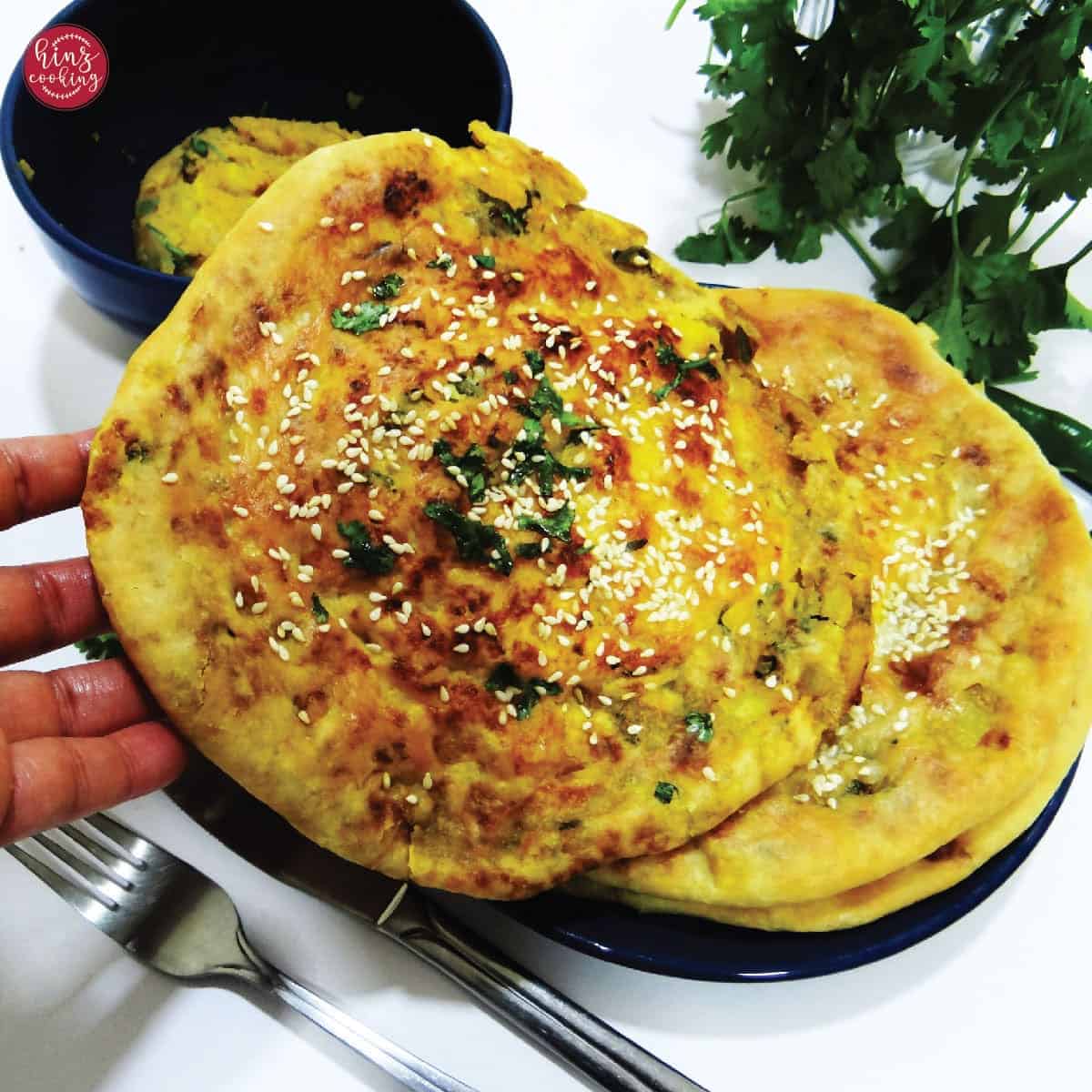
Aloo Naan — Spiced Potato Stuffed Naan (Oven, Tawa & Air Fryer)
Soft leavened naan dough filled with spiced mashed potato — golden, fluffy, and brushed with butter and fresh coriander the moment it comes out of the oven. My mother's recipe, made in my Dubai kitchen for 8 years. Three cooking methods included: oven for a tandoori-style crispy surface, stovetop tawa for a quick result, and air fryer for the crispiest finish in half the time.
Print
Pin
Servings: 6 Person
Calories: 245kcal
Ingredients
Potato (Aloo) Stuffing
- 5 Boiled Potatoes (Medium size) Boil until completely tender — a fork should pass through without resistance. Cool before mashing so the stuffing stays firm rather than sticky.
- 3 teaspoons vegetable oil Used to bloom the cumin and cook the onion. Neutral oil only — olive oil is too strong a flavor for the delicate spiced potato.
- ½ teaspoon cumin seeds Must be bloomed in oil first — raw cumin in the stuffing tastes harsh and grassy, bloomed cumin tastes warm and nutty
- ½ teaspoon green chilies, finely chopped Added with cumin to the oil. Use thin green chilies for more heat, thick jalapeno-style for milder. Adjust to your preference.
- 1 tablespoon onion, finely chopped Minimal quantity — just enough for sweetness and body without making the stuffing too wet. Finely chop so it cooks through in 1 minute.
- ½ teaspoon salt Season the stuffing well — under-seasoned filling makes the whole naan taste flat no matter how good the dough is.
- ½ teaspoon red chili powder Adds color and background heat. Use Kashmiri red chili for color without too much heat; regular red chili for more spice.
- ½ teaspoon chaat masala The flavor that makes this stuffing taste like proper street-style aloo — tangy, slightly sour, distinctive. Don't substitute. Use homemade or a good branded chaat masala.
- ⅓ teaspoon turmeric powder Gives the potato a warm golden color. Use sparingly — too much turmeric makes the filling bitter.
- 2 teaspoons fresh coriander (cilantro), finely chopped Added off the heat after the stuffing is cooked. Fresh coriander wilts and loses its flavor if cooked — always add at the end.
Naan Dough Ingredients:
- 11 g instant yeast (1 sachet) Always proof first in warm water with sugar — 5–10 minutes until frothy. If no froth, the yeast is dead. Never skip this step.
- 100 ml warm water (for yeast) Lukewarm — should feel warm on your wrist, not hot. 40–43°C (105–110°F). Too hot kills the yeast instantly.
- 1 teaspoon Sugar Feeds the yeast during activation. Also adds a barely perceptible sweetness to the finished naan that balances the spiced filling.
- 3 cups all-purpose flour (maida) Standard all-purpose flour. Don't use bread flour — its higher protein content makes the naan too chewy and tough for a stuffed bread.
- 1 tablespoon plain yogurt, full-fat Yogurt + baking (heat) = softer, more pliable naan that doesn't crack when you bend it around the stuffing
- 1 tablespoon oil (vegetable or neutral) Added to the dough for richness and to prevent drying out during the 2-hour rest. Do not skip or reduce.
- 1 teaspoon Salt Add to the flour — never directly onto the yeast as salt inhibits yeast activity if they come into direct contact before mixing.
- As needed warm milk (for kneading), optional Add gradually while kneading if the dough feels stiff. The exact amount depends on your flour brand and humidity. Add 1 tablespoon at a time until the dough is soft and slightly tacky.
Topping & Finish
- ½ tablespoon oil (for brushing baking tray/foil) Prevents naan sticking to foil during baking. Don't skip — foil without oil will stick to the base of the naan and tear it when you remove it.
- 2 teaspoons milk (for brushing naan surface) Brushed over the shaped naan before baking — gives the golden colour and helps sesame seeds adhere to the surface.
- 2 teaspoons white sesame seeds Pressed gently into the milk-washed surface before cooking. They toast lightly during baking and give a subtle nuttiness to the crust.
- 2 teaspoons butter, melted (for finishing) Brushed on immediately as naan comes out of the oven, pan, or air fryer while still steaming hot. Mixed with fresh coriander for the full street-style finish.
- 1 tablespoon fresh coriander (cilantro), finely chopped (for butter finish) Mixed into the melted butter and brushed on top at the end. Adds color, freshness, and aroma to the finished naan.
Instructions
Preparation of Potato (aloo) Stuffing:
- Bloom the cumin and chilies:Heat oil in a pan over medium heat. Add cumin seeds and chopped green chilies. Let them sizzle for 20–30 seconds until the cumin seeds darken slightly and the kitchen smells nutty and fragrant. Do not skip this step — raw cumin in the stuffing tastes harsh.
- Sauté the onion:Add finely chopped onion to the pan. Sauté on medium heat for 1 minute until softened and translucent. Don't brown — you want the onion to melt into the stuffing, not add texture.
- Add spices and cook out rawness:Add salt, red chili powder, chaat masala, and turmeric powder. Stir well to combine with the onion. Cook on medium heat for 1 minute, stirring constantly, until the raw smell of the spices disappears and the mixture smells aromatic.
- Add potatoes and mash:Add the boiled potatoes. Using a masher or the back of a wooden spoon, mash them roughly into the spiced onion base — you want a slightly textured mash, not completely smooth. Cook on low heat for 1–2 minutes, stirring, until the mixture is completely dry.
- Add coriander and cool:Remove from heat. Add freshly chopped coriander (cilantro) and mix through gently. Spread the stuffing on a plate and allow to cool completely to room temperature — at least 20 minutes — before stuffing the naan.
The stuffing must be completely dry before using. Any moisture will steam inside the dough during cooking, making the naan soggy and prone to breaking. If it looks wet, keep cooking on low heat until all moisture evaporates.
Never stuff naan with hot or warm filling. It softens and weakens the dough immediately on contact and causes tearing during rolling.
Make the Naan Dough
- Activate the yeast:In a large mixing bowl, combine instant yeast, warm water, and sugar. Whisk briefly and cover with a plate. Leave for 5–10 minutes until the surface is frothy and bubbling — this confirms your yeast is alive and active.
- Combine wet and dry ingredients:To the activated yeast, add yogurt and oil. Add all-purpose flour and salt. Mix together with your hands until a rough, shaggy dough forms.
- Knead the dough:Knead by hand for 8–10 minutes until the dough is smooth, soft, and slightly tacky. It should spring back slowly when you poke it. If the dough feels stiff or dry, add warm milk one tablespoon at a time and continue kneading. If it sticks to your hands, dust lightly with flour — maximum 2 extra tablespoons total.
- First rise — 2 hours:Lightly oil the dough ball and place back in the bowl. Cover tightly with plastic wrap or a damp kitchen towel. Place in a warm, draught-free spot for 2 hours until doubled or tripled in size. A switched-off microwave or oven with just the light on works perfectly.
If no froth appears after 10 minutes, the yeast is dead. Do not proceed — your naan will be flat and dense with no fix. Start with fresh yeast.
Add salt to the flour side — never drop it directly onto the yeast mixture before mixing, as direct salt contact inhibits yeast activity.
Soft, slightly tacky dough = soft naan. Resist adding extra flour — a tight dough makes hard, tough naan.
Do not rush this step. The 2-hour rise develops flavour and relaxes the gluten — making the dough easy to roll and the finished naan noticeably softer and more flavourful than a rushed dough.
Shape And Fill
- Knock back and divide:After 2 hours, turn the risen dough onto a lightly floured surface. Knead gently for 2 minutes to knock back the air. Divide evenly into 6 equal portions and roll each into a smooth ball.
- Roll out the first layer:Take one dough ball and roll or stretch into a circle approximately 15cm (6 inches) wide on a lightly floured surface. The circle should be thin but not so thin that it tears when you pick it up.
- Add stuffing and seal:Place 2–3 tablespoons of the cooled potato stuffing in the centre of the circle, leaving at least 3cm of clean dough around the entire edge. Bring the edges up and over the filling, gathering and pinching them together tightly at the top to completely seal in the potato. Twist any excess dough and remove it to keep the shape even and the base flat.
- Shape the naan:With the sealed side down, gently flatten the filled ball with your hands. Then roll carefully with a rolling pin into a circle or oval shape — approximately 20–22cm wide and just under 1cm thick. Apply gentle, even pressure — press too hard and the potato breaks through. Make dimple marks across the surface using your fingertips.
- Apply milk wash and sesame seeds:Brush the top surface generously with milk using a pastry brush — this gives the golden colour during cooking. Immediately sprinkle white sesame seeds over the surface and press in very lightly with your palm so they grip the dough and don't fall off during cooking.
Don't overfill. More than 3 tablespoons and the stuffing will push through the dough during rolling, creating weak spots that split during cooking.
Roll from the centre outward rather than back and forth. This distributes the filling evenly and prevents it pushing to one side.
Cook (Choose your method)
Oven Baked Method — Tandoori Style
- Preheat oven and prepare tray:Preheat oven to 200°C (392°F) for at least 10 minutes — the oven must be fully up to temperature before the naan goes in. Line a baking tray with aluminium foil and brush the foil generously with oil. An under-oiled tray will cause the naan base to stick and tear on removal.
- Baked the naan:Place shaped, milk-washed, sesame-topped naans on the prepared tray with space between each. Bake for 12 minutes until the surface is golden with slightly darker patches and the sesame seeds are lightly toasted. Check your first naan at 10 minutes — that becomes your benchmark for your specific oven.
- Butter finish:Remove from oven immediately. Brush generously with the butter-coriander mix while the naan is still steaming hot. The heat melts the butter into the surface, making it glossy and soft. Cover with a clean kitchen towel while you bake the remaining naans.
For extra softness: place a small oven-safe bowl of boiling water on the lower oven rack. The steam prevents the naan surface from drying out and produces a softer, chewier result.For a charred tandoori finish: switch to broil/grill for the final 60–90 seconds. Watch constantly — it goes from golden to burnt quickly.
Stovetop (tawa) Method
- Heat the skillet or tawa:Place a cast iron skillet or non-stick tawa over medium-high heat for 3–4 minutes until properly hot. A cold or lukewarm pan gives pale, steamed naan instead of golden spotted naan. Test by flicking a drop of water — it should evaporate immediately on contact.
- Non-stick pan method:Lightly wet one side of the shaped naan with a few drops of water. Place wet-side down onto the hot dry pan. Cook for 1–2 minutes until bubbles form across the surface and the bottom shows golden-brown spots. Flip and cook the second side for 1–2 minutes until golden. Cover with a lid for the last 30 seconds for extra puff.
- Cast iron — inverted flame method: Wet one side of the naan. Place wet-side down onto the hot cast iron skillet. Cook for 60–90 seconds until bubbles appear and the underside is golden. Using thick oven gloves, grip the skillet handles and flip it upside down over the gas flame. Rotate slowly for 30–60 seconds until the surface blisters and chars in spots. Return upright and remove naan with tongs.
- Butter finish:Brush with the butter-coriander mix immediately off the pan while still steaming. Serve immediately — stovetop naan is best eaten within 5 minutes of cooking while the surface is still slightly crisp.
⚠️ Safety: Cast iron only — never invert non-stick pans over direct flame. If your aloo naan is generously stuffed, use the non-stick flip method (16a) instead — heavily stuffed naan can slide off the inverted pan. See the full technique in my Cooking Methods guide.
Air Fryer Method
- Preheat the air fryer:Preheat air fryer to 180°C (360°F) for 3 minutes. Lightly spray or brush the basket with oil to prevent sticking. Do not skip preheating — a cold air fryer start gives uneven cooking and a pale, soft surface instead of the golden result.
- Air fry the naan:Place one or two shaped, milk-washed, sesame-topped naans into the basket — sesame side up. Do not overlap. Air fry at 180°C (360°F) for 6–8 minutes until golden with slightly darker patches on the surface and the sesame seeds are toasted. Check at 6 minutes — air fryers vary and thinner naans will be done faster.
- Butter finish:Remove from air fryer basket immediately. Brush generously with the butter-coriander mix while piping hot. The surface will be noticeably crispier than oven or tawa naan — this is the signature of air fryer aloo naan. Serve immediately.
Air fryer gives the crispiest aloo naan surface of all three methods — intense circulating heat creates an almost crackerlike exterior while the inside stays fluffy and soft. Ideal for 1–2 naans quickly. For larger batches, oven is more practical.
The naan rises significantly in the air fryer — more than in the oven. Make sure there is at least 3cm of space above the naan in the basket before you start. Do not open the air fryer in the first 4 minutes — the sudden loss of heat and air pressure will cause the naan to deflate and not puff properly. Check only after the 6-minute mark.
Air fryer naan crisps further as it cools — if you prefer softer, wrap in a clean kitchen towel for 2 minutes after buttering. The trapped steam softens the surface slightly.
Video
Notes
- Stuffing must be completely dry: any moisture in the potato filling will steam inside the dough during cooking, making the naan soggy and causing it to split. If the stuffing looks wet after mashing, cook on low heat until all moisture evaporates. This is the #1 cause of aloo naan breaking — more common than dough problems.
- Cool stuffing completely before using: hot or warm filling softens the dough on contact. Give it at least 20 minutes at room temperature. The fastest method: spread on a plate and place in the fridge for 10 minutes.
- Yeast must foam: always proof your yeast in warm water and sugar for 5–10 minutes before adding to flour. If it doesn't froth, the yeast is inactive — using it will give flat, dense bread with no solution. Start with fresh yeast.
- Don't overstuff: 2–3 tablespoons per naan is the right quantity. More causes blowouts during rolling. Less and the flavor payoff disappears in the bread. The filling should be visible at the edges when you hold the naan up to light — but never breaking through.
- Method comparison: oven gives the most even golden color and is best for larger batches. Tawa/stovetop gives the most authentic tandoor-style blistering and is fastest for 1–2 naans. Air fryer gives the crispiest exterior of all three and is best for small batches when you want maximum crunch.
- Leftover dough tip: refrigerate leftover naan dough overnight after the first rise. Use it for aloo naan the next day — the slow cold proof overnight makes the dough even more flavorful and easier to roll. This is the best version of this recipe I make — unplanned, using yesterday's dough.
- Wheat flour substitute: replace up to ½ cup of all-purpose flour with whole wheat flour (atta) for a slightly earthier, more traditional flavor and color. The texture will be slightly denser but still very soft with the full 2-hour rise.
- Freezing unbaked naans: place shaped, filled, uncooked naans between sheets of parchment paper on a tray. Freeze until solid (2 hours), then transfer to a freezer bag. Store up to 15 days. Cook straight from frozen in the oven at 200°C for 15–17 minutes or air fryer at 180°C for 10–12 minutes — no thawing needed. Do not freeze already-baked naans — they go rubbery when reheated.
- Storage: wrap cooled naans individually in aluminium foil. Room temperature: 1 day. Refrigerator: 3–4 days. Reheat: microwave for 1 minute then toast on a dry hot skillet for 1–2 minutes with a small knob of butter — this restores the crispy surface far better than microwave alone.
Nutrition
Serving: 1naan | Calories: 245kcal | Carbohydrates: 46g | Protein: 7g | Fat: 5g | Saturated Fat: 1g | Sodium: 380mg | Fiber: 3g | Sugar: 2g
