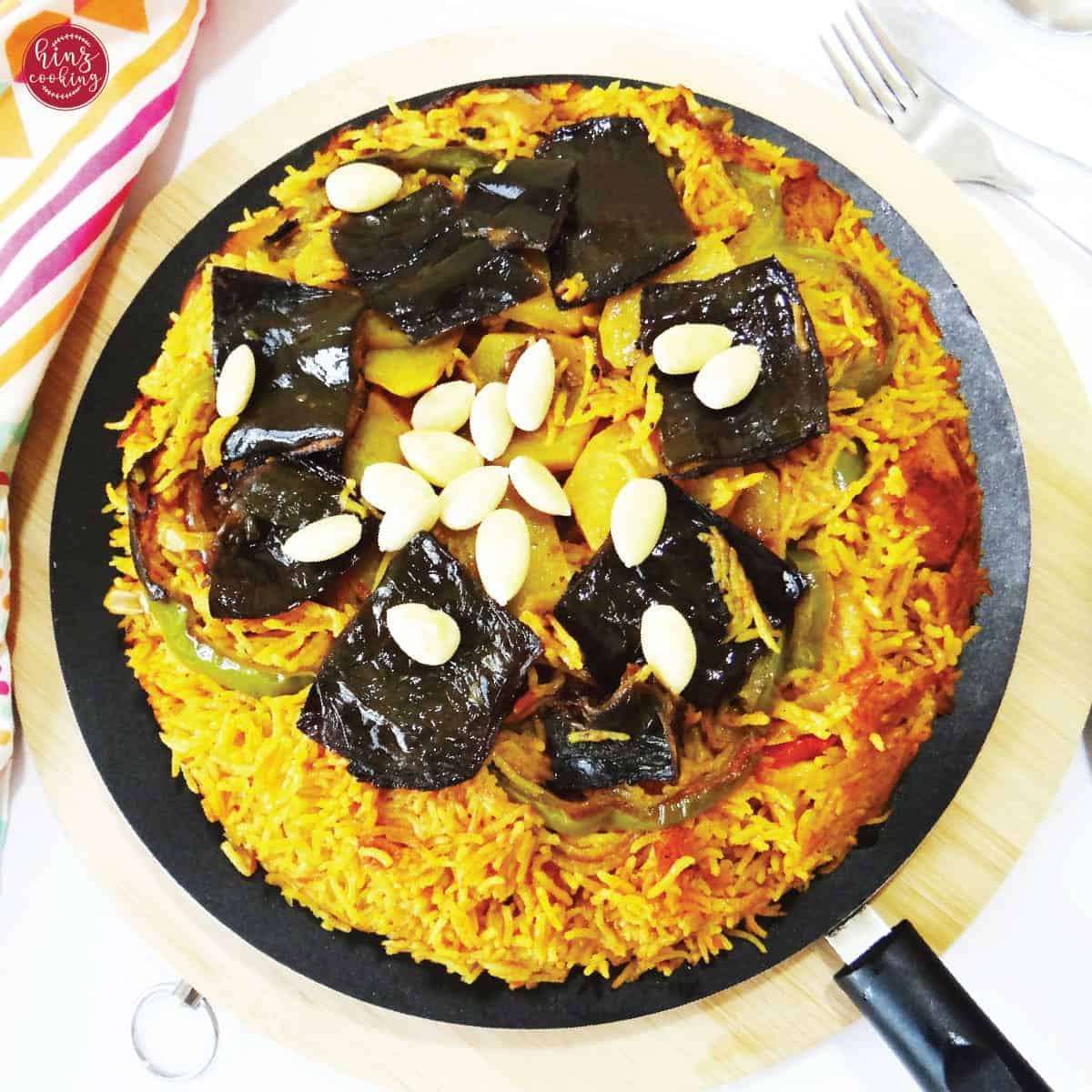
Chicken Maqluba — Authentic Palestinian Upside-Down Rice
Maqluba is Palestine's most celebrated dish — layers of spiced fried eggplant, golden potatoes, tender bone-in chicken and fragrant basmati rice cooked together in one pot, then flipped upside down onto a platter to reveal a dramatic layered tower. It looks impressive and tastes even better. This is the recipe I tested multiple times in my Dubai kitchen after tasting authentic maqluba at an Iraqi restaurant and a Syrian chef exhibition.
Print
Pin
Servings: 4 Persons
Calories: 536kcal
Equipment
- Maqluba Pot Deep non-stick pot (22–24cm diameter),
- Serving Platter large frying pan, serving plate wider than the pot
Ingredients
Chicken & Base
- 500 g Chicken Pieces (bone-in) Medium-sized pieces. Skin off — it makes the stock greasy. Bone-in is essential for a rich, flavorful stock that the rice absorbs.
- 2 tablespoons Oil Neutral oil — vegetable or sunflower. Used to sear the chicken and bloom the whole spices.
- 1 tablespoon Tomato Paste Adds depth and a slight color to the stock. Use concentrated paste — not fresh tomato and not tomato puree, which is too thin.
- 3 Cups Water (to make chicken stock) Added to the chicken pot to build the stock. You'll strain and measure after cooking — you need exactly 1.5× the volume of dried rice (3.75 cups stock for 2.5 cups rice).
Rice
- 2.5 cups Basmati Rice (long-grain) Washed and soaked in cold water for 30 minutes, then drained. Long-grain basmati stays separate and fluffy — essential for the flip to hold its structure.
- 1 teaspoon Oil (for toasting rice — optional Used in the optional pre-toasting step. Stir the soaked drained rice in a dry pan with this oil for 2 minutes before layering. Adds a subtle nuttiness and helps grains stay separate.
Vegetables
- 10 slices Eggplant ((aubergine), 1cm thick rounds) The star vegetable and the bottom layer — which becomes the top after the flip. Cut uniformly so it cooks evenly. Stir-fry until lightly golden before layering.
- 15 slices Potatoes (peeled, 1cm thick round) Second layer in the pot. Stir-fry until the outside is lightly golden — they continue cooking during the rice steaming stage so don't fully cook them now.
- 15 slices Onion (thick rings) Adds sweetness to the vegetable layer. Stir-fry until softened and slightly golden.
- 8 slices Capsicum (bell pepper), any color Adds colour and a mild sweetness. Red or yellow capsicum gives a more vibrant look after the flip.
- 6 slices Tomatoes (thick round) Placed near the top of the vegetable layer (just under the chicken). They soften completely during cooking and add juiciness to the dish.
Maqluba Spice Powder (mix together)
- 1 teaspoon Red Chili Powder Provides gentle background heat — not the dominant flavor. Maqluba is warmly spiced, not hot.
- 1 teaspoon Coriander Powder The most important flavor note in maqluba spice — earthy, citrus-like, and slightly warm. Don't skip.
- 1 teaspoon Curry Powder Adds complexity and a rounded warmth. Use a mild Pakistani-style curry powder.
- ½ teaspoon Turmeric Powder Gives the rice and vegetables a golden color. Use sparingly — turmeric can overpower if too much is used.
- 1 tablespoon Salt This seasons the whole dish — spice powder, vegetables, chicken, and stock. If your stock already has salt, reduce slightly.
Whole Spices (for chicken stock)
- 3 inches Cinnamon Sticks The dominant warm spice note in maqluba. Bloomed in oil before the chicken goes in — this releases the essential oils and builds flavor into the stock.
- 5 Green Cardamom Pods (lightly crushed) This releases the seeds and maximizes the floral, aromatic flavor in the stock.
- 5 Whole Cloves Adds a deep, slightly pungent warmth to the stock. Remove before serving if you prefer — they're intense to bite into.
Garnish
- 2 tablespoon Whole Almonds (toasted) Toast in a dry pan for 2–3 minutes until golden. Scatter immediately after the flip while the surface is still steaming — they adhere naturally.
Instructions
Prepare
- Soak The Rice: Wash basmati rice under cold running water until the water runs clear — usually 3–4 rinses. Submerge in cold water and soak for exactly 30 minutes. Drain completely through a sieve before using. Do not soak longer than 30 minutes.
- Mix the maqluba spice powder: In a small bowl, combine red chilli powder, coriander powder, curry powder, turmeric powder, and salt. Mix well until evenly combined. This single spice mix seasons everything — the vegetables, the chicken, and the stock — so getting it well-mixed matters.
Set a timer for 30 minutes the moment you add the water. Over-soaked rice breaks apart during the long cooking time and you'll lose the fluffy individual grains that make maqluba look beautiful after the flip.
Cook the components
- Stir-fry the vegetables: Cut all vegetables into uniform 1cm slices. In a large pan with 1 tablespoon oil over medium-high heat, stir-fry each vegetable separately — eggplant first, then potato, then onion, capsicum, and tomato. Sprinkle maqluba spice on each batch as it cooks. Fry until lightly golden on the outside, not fully cooked through. Remove each batch and set aside on a plate.
- Bloom the whole spices: In a large pot, heat 1 tablespoon oil over medium-high heat. Add the cinnamon stick, green cardamom pods (lightly crushed), and whole cloves. Let them sizzle and pop for 30 seconds — you'll smell the spices releasing immediately. This step builds the flavor foundation of your stock.
- Sear and cook the chicken: Add the chicken pieces to the pot. Cook on high heat for 3–4 minutes, turning once, until the outside changes color and develops a light golden crust. Add the maqluba spice powder and cook on high for 2 minutes — this eliminates the raw spice smell. Add tomato paste and stir through for 1 minute.
- Build the stock: Add enough water to fully submerge the chicken — approximately 3–4 cups. Cover the pot with the lid and cook on medium-low heat for 20 minutes until the chicken is completely tender and falling off the bone.Remove the chicken pieces carefully and set aside. Strain the stock through a fine sieve and measure it precisely. You need 3.75 cups of stock for 2.5 cups of rice.
- Toast the rice (optional but recommended): In a dry pan, heat 1 teaspoon of oil over medium heat. Add the soaked, drained rice and stir continuously for 2 minutes until the grains are lightly coated and slightly opaque. This step adds a subtle nuttiness and helps the grains stay separate throughout the long cooking time. Remove from heat and set aside.
Don't overcook the vegetables — they continue cooking during the 25-minute rice steaming stage. Overcooked vegetables become soggy and collapse during the flip, ruining the layered presentation.
The exact ratio: 1 cup dried rice needs 1.5 cups of stock. Measure before you pour — guessing is the most common cause of mushy or undercooked maqluba.
Assemble, Cook & Flip
- Oil the maqluba pot: Pour enough oil into the base of your deep non-stick maqluba pot to coat 2–3mm deep. Tilt the pot to coat the sides as well. This oil layer is what allows the eggplant to release cleanly during the flip — don't be stingy with it.
- Layer 1 — Eggplant (bottom of pot): Lay the stir-fried eggplant slices flat across the entire base of the pot, overlapping slightly to leave no gaps. This is the most important layer — it becomes the top of your maqluba after the flip. Take your time with this layer
- Layer 2 — Potatoes and remaining vegetables: Over the eggplant layer, distribute the potato slices evenly. Then add the onion rings, capsicum, and tomato slices in an even layer. Gently press down to compact the layers slightly — this prevents them sliding during the flip.
- Layer 3 — Chicken pieces: Arrange the cooked chicken pieces in a single layer over the vegetables. Try to create an even, stable layer — chicken pieces that stick out unevenly make the rice layer above them uneven, which affects both the flip and the final presentation.
- Layer 4 — Rice: Pour the rice over the chicken and spread evenly with a spoon, pushing it gently into the gaps between the chicken pieces so it fills the pot evenly on all sides. The rice should reach roughly to the top of the pot — it expands significantly during cooking.
- Add the stock and seal the pot: Pour the measured chicken stock carefully and evenly over the rice — pour slowly down the inside edge of the pot rather than directly onto the rice to avoid disturbing the layers. The stock should just reach the top surface of the rice. Cover the pot tightly with aluminium foil first, then place the lid firmly on top. The foil + lid seal traps steam and is what cooks the rice evenly.
- Cook the rice: Cook on medium heat for 10 minutes. Then reduce heat to the lowest possible setting and cook for a further 15–20 minutes. The rice cooks entirely by absorption and steam — do not lift the lid during this time. You'll hear the sizzling decrease and the stock smell intensify as the rice absorbs the liquid.
- The flip: After the 5-minute rest, choose a serving platter that is at least 5cm wider than the pot diameter on all sides. Place the platter firmly on top of the pot. Using thick oven gloves, grip both the pot handles and the platter edge simultaneously. In one confident, continuous motion — without pausing halfway — flip the pot upside down and lower the platter to a flat surface. Set down gently. Wait 30 seconds. Tap the base of the pot with a wooden spoon 3–4 times. Lift the pot straight upward in one smooth motion.
- Garnish and serve immediately: Scatter toasted almonds over the eggplant surface while the maqluba is still steaming — the heat helps them adhere. Add raisins and freshly chopped parsley if using. Serve immediately at the table with yogurt raita and a simple salad alongside. Maqluba is always served fresh — the layers are most intact in the first 10 minutes after the flip.
Cover the entire base with no gaps showing. Any pot base visible through the eggplant layer will be a bare patch of rice on top after the flip.
If stock overflows the rice surface, remove a little before sealing. Too much stock makes the bottom layers soggy and the flip will collapse.
After 25 minutes total, remove the pot from heat. Keep the lid and foil on. Rest for 5 minutes — this is not optional. The rest sets the layers and prevents collapse during the flip.
💡 Hina's Flip Method — I broke my first two attempts. The first time I used a plate that was too small — the maqluba slid off sideways. The second time I hesitated mid-flip and the layers shifted. The solution: (1) always use a platter significantly larger than the pot, (2) commit to the flip without stopping — confidence is the technique. The 5-minute rest before flipping is what locks the layers in place.
Video
Notes
- Stock ratio is the most critical step: measure exactly 1.5 cups of stock for every 1 cup of dried rice. For this recipe: 2.5 cups rice needs 3.75 cups stock. Too much stock = mushy, collapsed flip. Too little = raw, grainy rice. Measure before you pour.
- Pot selection controls the final shape: a tall, narrow pot gives a tall tower presentation. A wide, shallow pot gives a low dome. For a family portion (500g chicken, 2.5 cups rice), use a 22–24cm diameter pot. The serving platter must be at least 5cm wider than the pot on all sides — this is the #1 reason maqluba collapses on flip.
- The 5-minute rest before flipping is not optional. Remove from heat, keep the foil and lid on, and rest for 5 full minutes. This sets the layers. Flipping a pot that's still at maximum steam pressure is what causes collapse.
- Never use chicken with skin. Skin releases fat into the stock making it greasy — the rice surface after flipping will look oily rather than golden. Always remove skin before cooking.
- Don't soak rice for more than 30 minutes. Set a timer. Over-soaked rice breaks down during the 25-minute cooking time and the grains lose the separation that makes maqluba visually beautiful after the flip.
- Lamb or mutton version: use the exact same recipe and ingredients. Increase the meat cooking time in Step 6 from 20 minutes to 45–60 minutes until the meat is completely fall-off-the-bone tender. Lamb stock is richer and darker, giving the rice a deeper color and more complex flavor.
- Vegetable variations: cauliflower (traditional in Jordanian maqluba), zucchini, and carrots all work well as additions or substitutions. Always stir-fry before layering — raw vegetables release too much water during cooking and dilute the stock ratio. Roasting vegetables in the oven at 200°C for 20 minutes instead of stir-frying is a lower-oil alternative that also works well.
-
If the vegetable layer sticks after flipping: this is caused by insufficient oil on the pot base before layering, or overcooking. Use a non-stick pot and apply oil generously to both the base and the sides before the eggplant layer. If a small amount sticks, use a spatula to lift it onto the platter and patch the presentation — it happens to everyone on the first few attempts.Storage: maqluba keeps in the fridge for up to 3 days in an airtight container. Reheat in a pan over low heat with 2 tablespoons of water, covered, for 8–10 minutes. The microwave makes the rice rubbery — the pan method is significantly better.
Nutrition
Serving: 400g | Calories: 536kcal | Carbohydrates: 72g | Protein: 38g | Fat: 14g | Saturated Fat: 3g | Sodium: 820mg | Potassium: 95mg | Fiber: 4g | Sugar: 5g
