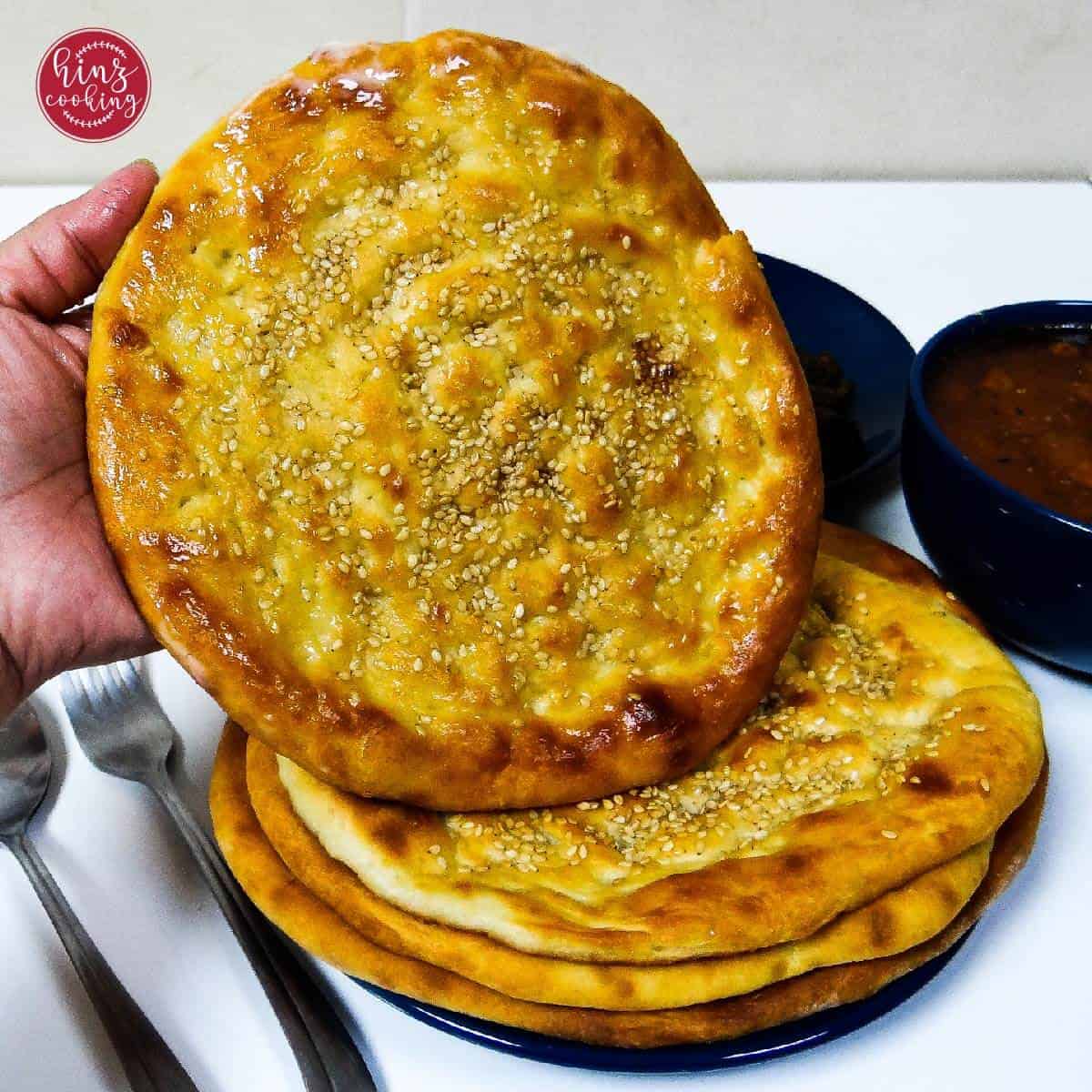
Roghni Naan (Pakistani Butter Naan)
Soft, pillowy, and brushed with butter the moment it comes out of the oven — this is Pakistan's signature celebration bread. Roghni naan is richer than regular naan thanks to ghee in the dough, full-fat yogurt for tenderness, and a generous sesame seed crust. No tandoor needed — oven, stovetop, or broiler all work perfectly. Once you make this at home, restaurant naan will never be quite enough again.
Print
Pin
Servings: 6 People
Calories: 235kcal
Ingredients
Naan Dough
- 2.5 cups All Purpose Flour (Maida) Main structure of the naan. Use good quality unbleached APF — it makes a real difference to chew and color.
- 1 Cup Wheat Flour (Atta) Adds structure, slight earthy depth, and the traditional Pakistani naan color. Don't skip or substitute with more APF — the dough will be too soft to hold its shape with the high oil content.
- 11 g Instant Yeast Slightly more than a standard 7g packet — ensures a reliable rise even in cooler kitchens or with older flour. Always proof it first in the warm water before mixing.
- ½ cup Lukewarm Water (for yeast activation) Used only to activate the yeast — not as the main hydration for the dough. Temperature matters: 40–43°C (105–110°F). Too hot kills the yeast instantly.
- 1 tablespoon Sugar Feeds the yeast during activation (speeds up the froth) and adds the faintest hint of sweetness that balances the salt and richness of the ghee finish.
- 1 teaspoon Salt Controls yeast activity and balances the richness. Add it to the flour — never directly onto the yeast as it can inhibit activation.
- ½ teaspoon Baking Powder Works alongside the yeast for the final puff in the oven. Gives the naan that last burst of rise that creates the airy interior pockets.
- ⅓ teaspoon Baking Soda Reacts with the yogurt (even just 1 tablespoon of it) to create additional lift and a slightly more tender crumb. The small amount is intentional — too much makes naan taste soapy.
- 1 tablespoon Plain Yogurt (Full-Fat) Minimal compared to most naan recipes — and deliberately so. The oil (below) is handling the softness. The yogurt's job here is purely to provide mild tang and activate the baking soda.
- ⅓ cup Oil (or Melted ghee / Butter) This is the highest fat ratio of any ingredient — and intentionally so. This is what makes roghni naan richer than plain naan. Oil coats the gluten strands, keeping the naan tender and preventing it from becoming chewy or tough. Do not reduce this amount.
- warm milk (for kneading) Optional (As needed) - Add gradually while kneading until the dough is soft and slightly tacky. Milk adds colour, tenderness, and flavour that water alone cannot. Add a tablespoon at a time — the exact amount varies by flour brand and humidity.
Topping
- 2 pinches White Sesame Seeds The signature of roghni naan. They toast lightly during baking, adding a subtle nuttiness to every bite. Press them gently into the milk-washed surface so they don't fall off during cooking.
- 1 teaspoon Milk (for brushing before baking) Gives the naan its golden colour and helps sesame seeds adhere. Brush generously just before going in the oven.
Finishing
- 1 teaspoon Butter (melted, for brushing after baking) Brush immediately while the naan is still hot — the heat melts the butter into the surface, making it glossy and soft. This is non-negotiable for the roghni finish.
Instructions
Dough preparation
- Activate The Yeast: In a mixing bowl, combine ½ cup lukewarm water, 1 tablespoon sugar, and 11g instant yeast. Stir briefly, cover with a plate, and leave for 10–15 minutes. The mixture must become frothy and bubbling — this confirms your yeast is alive and active.[Note]: If nothing happens after 15 minutes, the yeast is dead. Don't continue — your naan will be flat. Start fresh with new yeast.
- Combine Dry Ingredients:To the activated yeast, add the all-purpose flour, wheat flour, salt, baking powder, and baking soda. Mix briefly with your hand to distribute the leavening agents evenly through the flour before adding the wet ingredients.
- Add wet ingredients and bring dough together:Add oil and yogurt to the flour mixture. Using your hands, crumble and mix everything together until it starts to combine. Add warm milk gradually — a tablespoon at a time — kneading as you go, until a soft dough forms. Knead for 8–10 minutes until smooth, soft, and slightly tacky. It should spring back when you press it.[Note]: The dough should feel softer than you expect — almost a little sticky. That softness is the oil working. Resist adding extra flour.
- Proofing — Rise for 2 hours:Lightly brush the dough with oil, cover the bowl tightly with plastic wrap or a damp cloth, and place in a warm draft-free spot for 2 hours until doubled in size. A switched-off oven with just the light on is ideal. Do not open or disturb the dough during this time.[Note]: Don't rush this step. The 2-hour rise isn't just about size — it's building flavor. Fast-proofed naan tastes flat even if it puffs up.
Naan Shaping
- Knock back and divide:After 2 hours, turn the risen dough onto a lightly floured surface. Knead gently for 2–3 minutes until soft and springy. Divide into equal portions — from 3.5 cups of flour you'll get approximately 6 medium naans or 4 large ones.
- Roll each ball with the help of rolling pin or hands to create flat naan.
- Shape each naan: Using your hands or a rolling pin, flatten each ball into an oval or teardrop shape, roughly 8–9 inches long and ¼ inch thick. Use minimal flour for dusting — just enough to prevent sticking. Hand-stretching gives the most authentic, uneven surface.[Note]: Irregular shapes are traditional — uniform naan was made by a machine. Don't worry about perfect edges.
- Mark, brush and top:Press the traditional dimple pattern across the surface using the fingertips of both hands — press firmly but not through the dough. Watch the video for the exact finger technique. Alternatively, use a naan stamp for uniform marks. Brush generously with milk and immediately sprinkle sesame seeds across the surface, pressing in lightly with your palm.
Cook (Choose Method)
Oven (Recommended)
- Bake at 220°C (428°F)Preheat oven to 220°C (428°F) for at least 10 minutes. Line a baking tray with parchment paper and grease lightly. Place naans with space between each. Bake for 10–15 minutes — in my oven they are perfect at 12 minutes. Watch for golden-brown tops and lightly toasted sesame seeds.[Note]: Check your first naan at 10 minutes. That becomes your benchmark — every oven runs slightly different.
- Butter finish immediately:The moment naans come out of the oven, brush generously with melted butter. Stack and cover with a clean kitchen towel to keep warm and soft while you bake the remaining naans.
- As soon as you take them out of the oven, brush with butter.
- Roghni naan is ready to serve.
Stovetop / Tawa / Griddle / Skillet
- Cook on a hot tawa or cast iron skillet:Heat a heavy skillet or tawa on medium-high for 3–4 minutes until very hot. Place naan sesame-side up on the dry pan (no oil). Cook 1–2 minutes until bubbles form across the surface. Flip and cook the other side 1–2 minutes until golden spots appear. Cover with a lid for the last 30 seconds for extra puff.[Note]: The pan must be properly hot before the naan goes in — a lukewarm pan gives you steamed, pale naan instead of the golden spotted finish.
- Butter finish immediately:Brush with melted butter or ghee straight off the pan. Sprinkle extra sesame seeds if desired. Serve immediately.
Broiler / Griller
- Preheat broiler and stone/tray:Place oven rack on the highest position. Preheat broiler/grill on full high heat with a heavy baking tray or pizza stone inside for 10 minutes. Carefully place naans on the hot surface. Broil 2–3 minutes until puffed with char spots. Flip and broil 1–2 minutes more.[Note]: Watch constantly under the broiler — it goes from perfect to burnt in under a minute.
- Butter finish immediately:Brush with melted butter or ghee immediately. This method gives the closest result to tandoor naan — slight char, smoky edge, soft interior.
Video
Notes
- Why this recipe uses ⅓ cup oil: this is higher than most naan recipes — and intentionally so. The oil coats the gluten strands, keeping each naan tender and soft for hours. Reducing it will make your naan tougher. Don't substitute with less.
- Wheat flour is not optional: the 1 cup of atta (whole wheat flour) gives the dough structure to hold the high oil content without becoming too delicate. Replacing all of it with APF produces a naan that tears too easily when shaped.
- Yeast test is non-negotiable: always proof your yeast in warm water + sugar for 10–15 minutes before adding to flour. If it doesn't foam, your yeast is inactive — using it will give you flat, dense bread. Start fresh.
- Milk for kneading — add gradually: the exact amount varies by flour brand, humidity, and temperature. Add warm milk one tablespoon at a time until the dough is soft and slightly tacky. You may need anywhere from 2 tablespoons to ¼ cup depending on your flour.
- Why my naan turned out hard: most likely cause is under-proofing (didn't rise fully for 2 hours), too much flour added while rolling, overbaking, or leaving naan uncovered after cooking. Always cover finished naan immediately with a kitchen towel.
- Make-ahead dough: after the first rise, divide into balls, coat lightly with oil, wrap each in plastic wrap, and freeze up to 2 months. To use: thaw overnight in the fridge, then rest at room temperature 30–45 minutes before shaping. Frozen dough naan tastes just as fresh as same-day.
- Storage: wrap in foil or cover with a cloth. Room temperature: 1 day. Refrigerator: up to 3 days. Freezer (baked): up to 2 months with parchment between each. Reheat on a dry skillet with a small knob of butter for 1–2 minutes.
Nutrition
Serving: 1naan | Calories: 235kcal | Carbohydrates: 36g | Protein: 6g | Fat: 8g | Saturated Fat: 1g | Cholesterol: 5mg | Sodium: 320mg | Fiber: 2g | Sugar: 2g
