
The first samosa I ever ate came from a street vendor outside my school in Karachi. He kept a coal-heated kadhai — a deep iron wok — on a cart, and the samosas sat in a wire basket above the oil to stay warm. They were small, triangular, and the pastry was paper-thin. The filling inside was minced lamb cooked down with ginger, garlic, and a handful of whole spices.
I have been trying to recreate that samosa ever since.
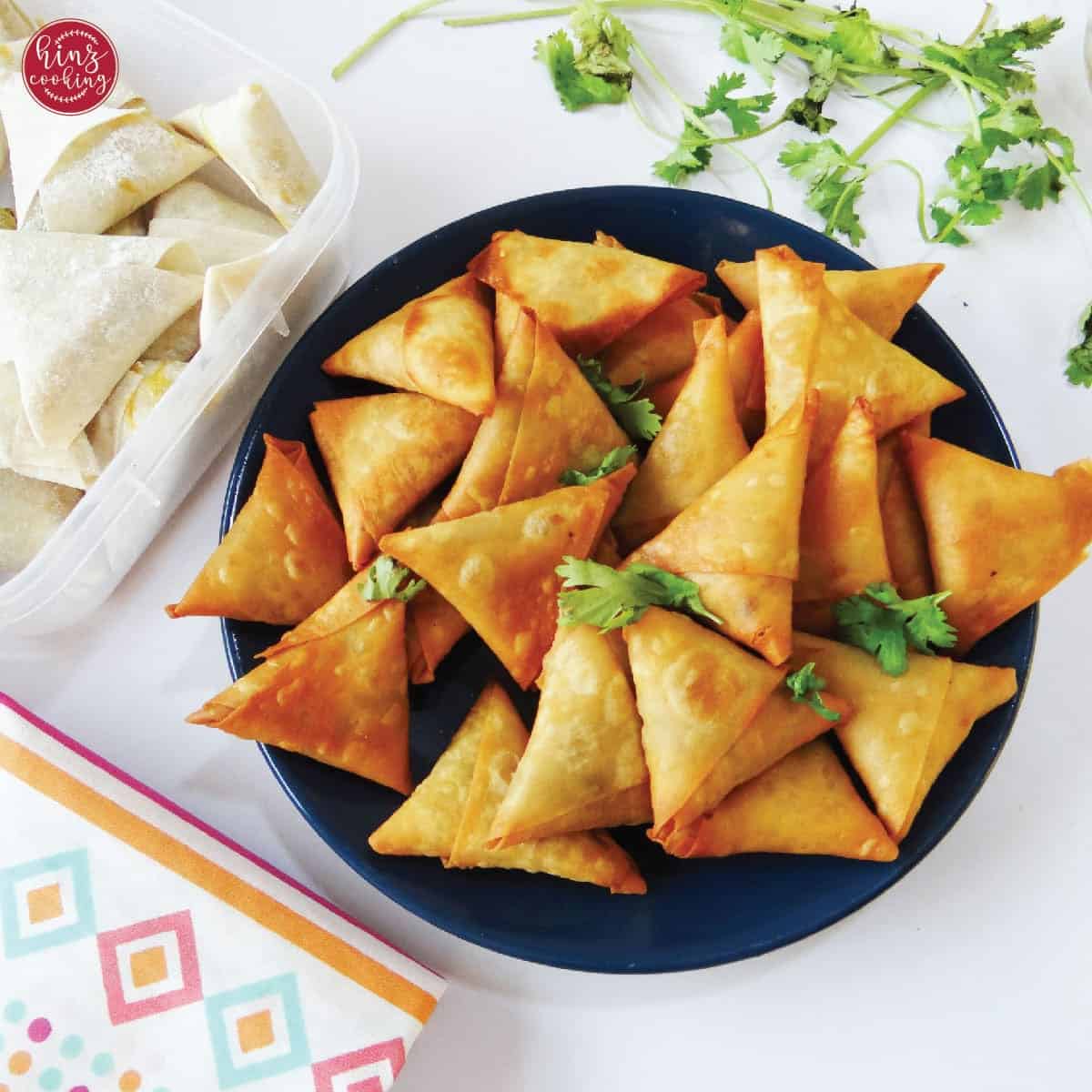
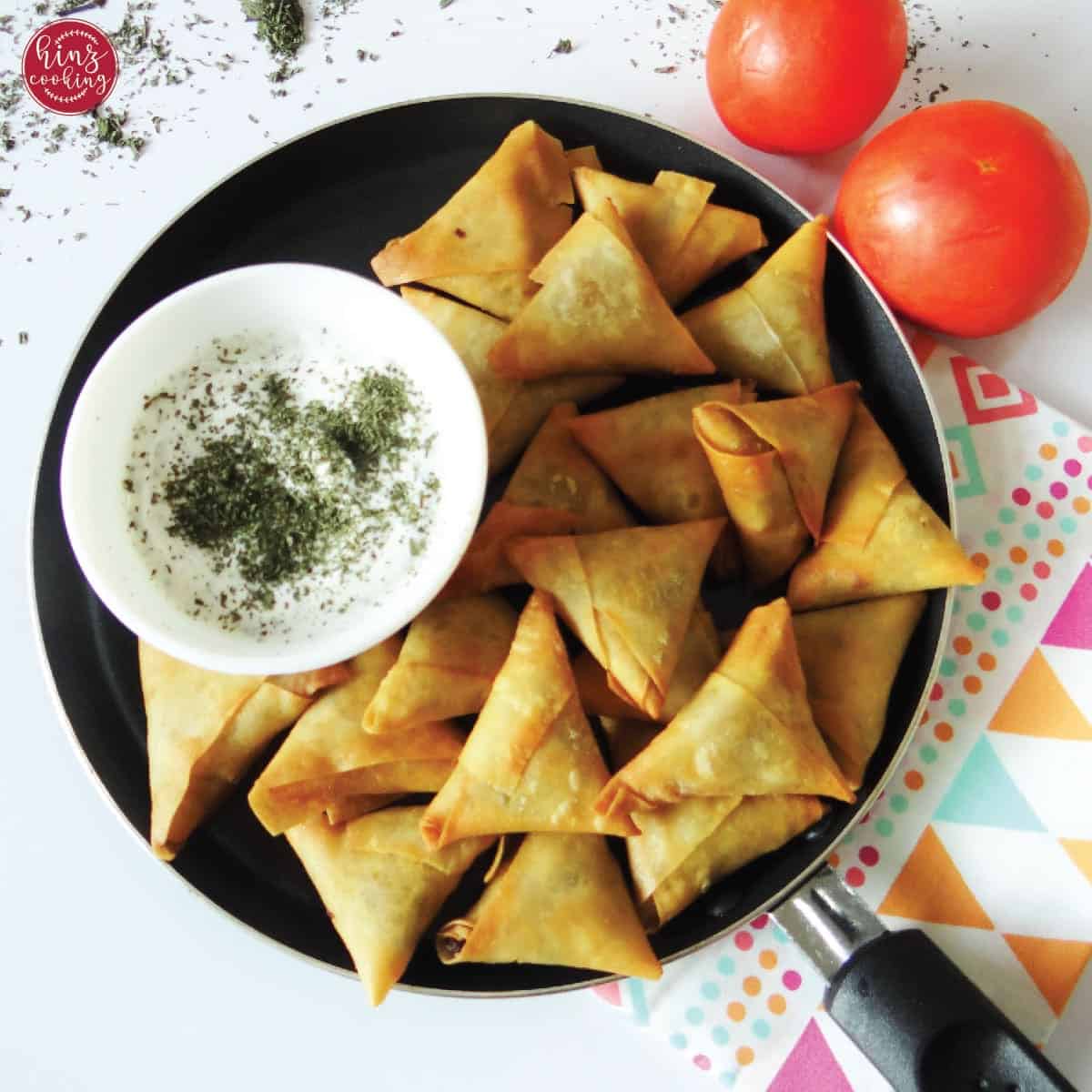
This keema samosa recipe is as close as I have come. The lamb mince is cooked slowly with spices until completely dry — no excess moisture, which is what makes the pastry stay crispy rather than going soggy when it hits the oil. The flour paste seals the edges cleanly. The frying temperature is precise enough that the patti crisps in layers rather than hardening in one thick shell.
In Dubai, I make these for Ramadan iftar every year — a full tray of them, frozen in batches so we can fry fresh every evening. They disappear within minutes.
Jump to:
What is Keema Samosa?
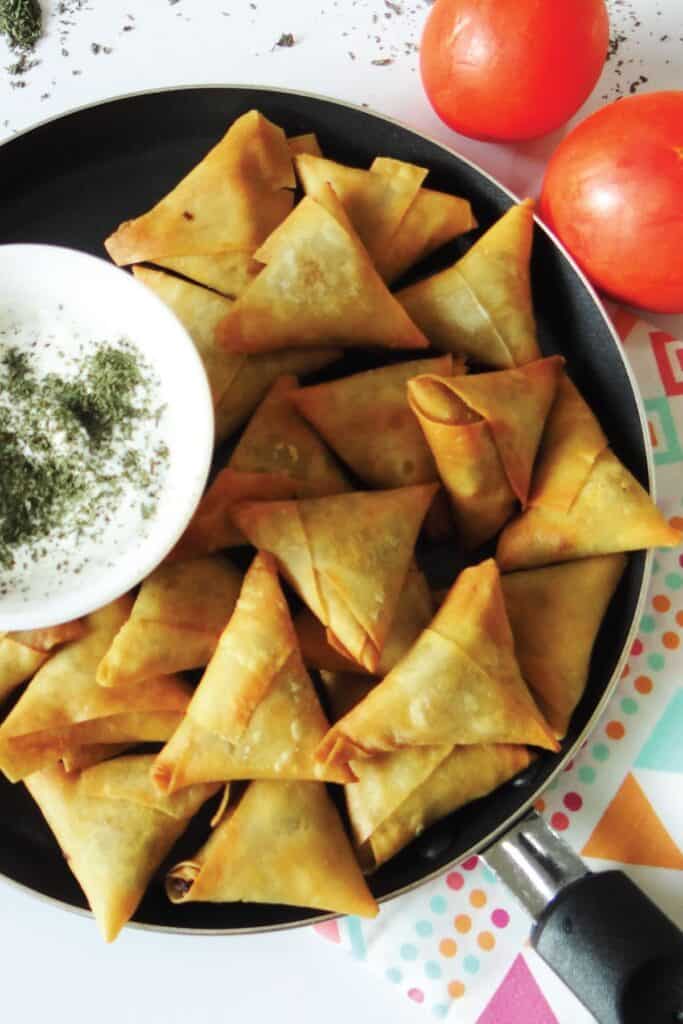
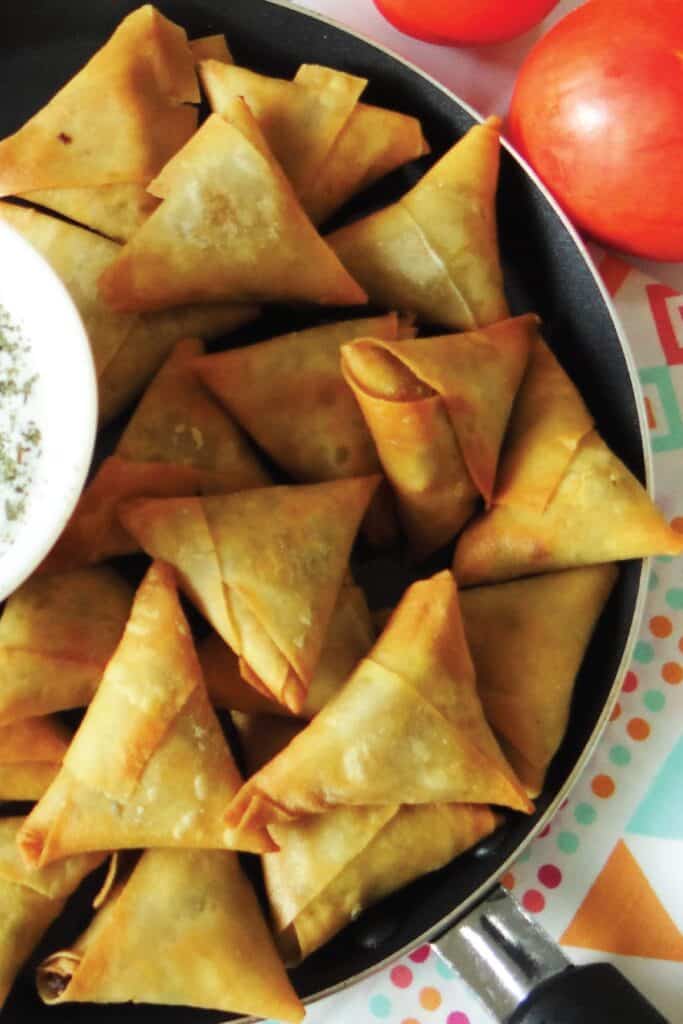
Keema samosa (کیما سموسہ) is a deep-fried Pakistani and South Asian pastry snack made by filling thin samosa patti sheets (also called samosa pastry or wonton-style wrappers) with a dry-cooked spiced minced meat filling — typically lamb, beef, or mutton — folding into a triangular shape, sealing the edges with flour paste, and deep frying until golden-brown and crispy.
"Keema" (کیما) is the Urdu and Hindi word for minced or ground meat. "Patti samosa" refers specifically to the thin pastry sheet version — as distinct from the thicker dough-wrapped samosa that is hand-rolled at home.
In Pakistan, keema samosa is the most popular version of samosa for Ramadan iftar, street food, and party platters. In Middle Eastern and East African countries it is known as Sambusa — a very similar concept made with the same spiced meat filling.
Keema samosa vs vegetable samosa — the key differences
| Keema Samosa | Vegetable Samosa | |
|---|---|---|
| Filling | Spiced lamb/beef/mutton mince | Spiced potato and peas |
| Cooking time | Longer (meat needs 30 min to tenderize) | Faster (potato cooks in 15 min) |
| Texture inside | Juicy and tender | Soft and crumbly |
| Common in | Pakistan, Bangladesh, East Africa | India, Pakistan, UK |
| Protein | High — lamb mince | Lower |
| Freezes well? | Yes — excellent | Yes |
Ingredients
(makes 18–20 samosas, serves 6)
For the keema (meat filling)
- 150g lamb mince — the most authentic choice for Pakistani street-style samosa. The fat content in lamb keeps the filling moist even after frying. Beef mince and mutton mince both work — use the same quantities. Chicken mince is also good but needs slightly less cooking time (20 minutes instead of 30).
- 1 tablespoon oil
- 1 tablespoon onion, finely chopped — for the keema base. A second tablespoon of fresh chopped onion is added raw at the end — this is the detail that gives the filling its fresh crunch.
- 1 teaspoon garlic, freshly grated
- 1 teaspoon ginger, freshly grated
- 1 teaspoon green chilies, sliced — adjust to your heat preference
Spice blend
- 1 teaspoon coriander powder (dhania powder)
- ½ teaspoon cumin powder (zeera powder)
- ½ teaspoon turmeric powder (haldi)
- ⅓ teaspoon mango powder (amchoor) — adds the slight sourness that defines Pakistani street keema
- 1 teaspoon salt
- 1 teaspoon red chili powder
- 1 teaspoon garam masala powder
Finishing the keema
- ½ cup water — added mid-cooking to help tenderize the meat
- 1 tablespoon fresh onion, chopped — added raw at the end for crunch
- 1 tablespoon fresh coriander (cilantro), chopped — added at the end for freshness
For the flour paste (samosa seal)
- 1 tablespoon wheat flour (or all-purpose flour)
- 2 tablespoons water Mix to a thick, smooth paste — consistency of glue. This is what seals the samosa edges so they don't open in the oil.
For wrapping and frying
- 20 sheets ready-made samosa patti — also sold as samosa pastry sheets, spring roll sheets, or wonton wrappers. The thinner the sheet, the crispier the samosa. Available in South Asian and Middle Eastern supermarkets in the freezer section.
- Oil for deep frying — sunflower, canola, or vegetable oil. Use a neutral oil with a high smoke point.
How to Make Keema Samosa — Step by Step
Prep time: 10 minutes | Cook time: 35 minutes | Total: 45 minutes | Makes: 18–20 samosas
Step 1 — Cook the keema filling
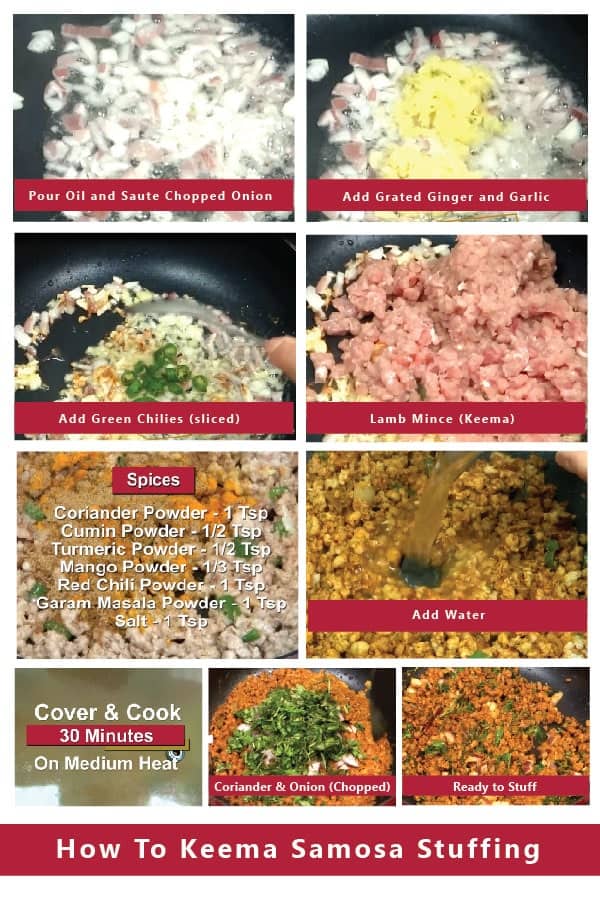
Heat 1 tablespoon of oil in a pan over medium heat. Add the chopped onion and sauté for 3–4 minutes until light golden. Add the grated garlic, grated ginger, and sliced green chilies. Cook for 1–2 more minutes until the raw smell of garlic cooks off.
Add the lamb mince. Increase heat to high. Stir continuously and break apart any clumps with a spoon. Cook on high heat until the mince changes color completely from pink to brown — approximately 4–5 minutes. If the mince releases water, keep the heat high and let it evaporate completely before adding the spices.
The mince must be completely dry before the spices go in. Wet keema produces soggy samosas — the moisture seeps through the patti during frying. This is the most common reason homemade samosas lack the crispiness of street-food versions.
Add coriander powder, cumin powder, turmeric powder, mango powder, salt, red chili powder, and garam masala powder. Stir quickly for 30–45 seconds to bloom the spices in the oil.
Add ½ cup of water and stir well. Reduce heat to medium, cover the pan, and cook for 30 minutes until the lamb is fully tenderized and the water has been completely absorbed.
After 30 minutes, uncover and check — there should be no liquid remaining. If any moisture remains, increase heat and stir until completely dry.
Add 1 tablespoon of fresh chopped onion and 1 tablespoon of fresh coriander. Mix well on high heat for 1 minute. The stuffing is ready. Set aside to cool completely before filling — hot filling causes the patti to tear and makes handling very difficult.
Step 2 — Make the flour paste
In a small bowl, mix 1 tablespoon of wheat flour with 2 tablespoons of water. Stir until smooth with no lumps. The paste should be thick enough to cling to the pastry without dripping — similar to the consistency of school glue. Set aside.
Step 3 — Prepare the samosa patti
If using frozen patti sheets, thaw completely at room temperature before use. Never use patti straight from the freezer — it will crack when you try to fold it.
Keep unused patti covered with a slightly damp cloth or kitchen towel while you work. Exposure to air dries the sheets and makes them brittle, which causes cracking and breaking at the edges.
Check each sheet before using — if it is torn or has dry, papery patches, discard it. A compromised sheet will break in the oil regardless of how carefully you fold it.
Step 4 — Fold the samosa
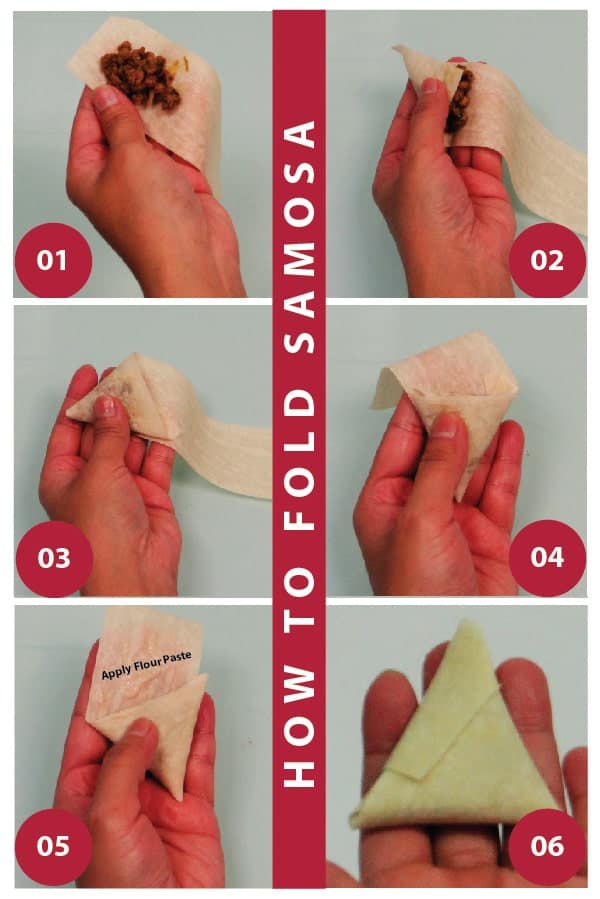
Take one patti sheet and hold it lengthways (long side horizontal). Fold the right third of the sheet over toward the centre, creating a triangular pocket at the top right corner. Apply a thin line of flour paste along the edge you just folded.
Fold the triangular pocket down and over itself to form a cone shape. Press the glued edge firmly to seal.
Place 1 teaspoon of cooled keema stuffing inside the cone — do not overfill. Overfilling is the second most common samosa mistake. The filling should sit loosely inside, not be packed in tightly.
Fold the remaining flap of patti over the filled cone, applying flour paste along all exposed edges. Press firmly and hold for a few seconds to seal. The finished samosa should be a tight, closed triangle with no gaps or unsealed edges.
For beginners: watch the video below before you start folding. I demonstrate two folding methods — the standard triangular fold and a quicker pocket fold. Most people find the pocket method easier on the first attempt.
Place finished samosas on a tray without stacking. Do not place them touching each other or the flour paste seals will merge.
Step 5 — Deep fry
Pour oil into a deep wok or heavy pan to a depth of at least 8cm (3 inches). Heat to 175°C / 350°F. Test without a thermometer by dropping a small piece of patti into the oil — it should rise to the surface and bubble immediately within 2–3 seconds.
Lower the samosas into the oil gently — never drop them in. Fry in batches of 4–5 maximum. Do not overcrowd.
Start on medium-high heat for the first 2 minutes, then reduce to medium for the remaining 3–4 minutes. This two-stage frying crisps the outside quickly then allows the inside to heat through completely without burning the patti.
Fry for 5–6 minutes total, turning once or twice, until deep golden-brown on all sides. A pale golden samosa is undercooked — the patti will be soft, not crispy. Wait for a rich, deep golden color.
Remove with a slotted spoon and drain on paper towels. Do not cover immediately — trapping steam makes the patti go soggy.
Alternative Cooking Methods
Air fryer keema samosa
Preheat air fryer to 200°C / 390°F for 3 minutes. Spray the samosas lightly with oil on all sides. Arrange in a single layer in the basket — do not overlap. Air fry for 10 minutes, then flip and air fry for a further 8–10 minutes until deep golden. Spray with additional oil after flipping for a crispier result. Air fryer samosas are excellent — the texture is very close to deep fried with significantly less oil.
Baked keema samosa
Preheat oven to 220°C / 430°F. Place samosas on a lined baking tray. Brush generously with oil on all sides — do not skimp, baked samosas need oil to crisp the patti. Bake for 15 minutes, flip, and bake for a further 10–12 minutes until golden. Baked samosas are less crispy than fried or air-fried but completely acceptable if oil reduction is the priority.
Crispy Samosa — Pro Tips
The keema must be completely dry. Moisture in the filling is the single biggest cause of soggy samosas. After cooking the keema, let it cool on the pan with no lid — any remaining steam will evaporate. Only fill the patti when the keema is completely cool and dry.
Thin patti = crispier samosa. The best samosa patti for deep frying is the thinnest available. Check the packet — spring roll sheets and samosa pastry sheets are often the same product sold under different names. Avoid thick filo-style pastry.
Seal every edge completely. Hold the sealed edge firmly for 5 seconds after applying the flour paste. If any edge is improperly sealed, hot oil enters the samosa during frying and the filling spills out, ruining the batch.
Do not skip cooling the filling. Hot keema releases steam inside the patti envelope — it softens the pastry from the inside before the outside even hits the oil. Always fill with completely cooled keema.
Freeze raw, not cooked. Frozen uncooked samosas fry from frozen in 8–9 minutes (add 2–3 minutes to the standard frying time). Frozen cooked samosas lose their crispiness when refired. The uncooked frozen method produces a far better result.
Oil temperature is everything. Too cool and the samosa absorbs oil instead of frying. Too hot and the outside burns before the inside heats through. 175°C / 350°F is correct — test with a thermometer or the patti test before the first batch.
SEE ALSO: Easy Tips To Deep Fry
What To Serve With Keema Samosa
Classic Pakistani accompaniments:
- Green Chutney (Hari Chutney) — the essential dipping sauce for any Pakistani samosa. The sharp, herby freshness cuts through the richness of the fried pastry perfectly.
- Chaat Masala — sprinkle directly over hot samosas before serving. Adds a tangy, slightly sour kick that transforms the flavor.
For a full Pakistani snack spread:
- Chana Chaat — spiced chickpea chaat alongside samosas is the classic Ramadan iftar combination across Pakistan
- Dahi Bhalla — yogurt-based lentil fritters; serve together for a complete iftar snack platter
- Pakora Recipe — crispy onion and potato fritters; the natural samosa companion
- Indian Samosa — the vegetable-filled finger-style samosa version; make both for a mixed platter
- Roasted Chickpeas (Air Fryer) — a lighter snack to complete a spread
For Ramadan iftar specifically: Serve keema samosa hot from the oil at iftar alongside a bowl of green chutney, chana chaat, and dates. In Karachi this is the standard iftar table — the combination of fried, spiced, sweet, and tangy covers every taste the fast-breaking meal calls for.
How To Store And Freeze Keema Samosa
Freezing uncooked samosas (best method)
Line a tray with parchment paper. Place the filled, sealed, raw samosas on the tray in a single layer without touching. Freeze for 1–2 hours until completely solid. Transfer to a ziplock bag or airtight container. The pre-freezing step prevents them from sticking together.
Method 2 (no tray needed): Dust the base of an airtight container with flour. Place a single layer of samosas, dust with more flour, add another layer, and repeat. The flour prevents sticking. Freeze for 1 hour then shuffle to separate any that have touched.
Frozen life: Up to 1 month (without preservatives).
To cook from frozen: Deep fry at 170°C / 340°F (slightly lower than fresh) for 8–9 minutes. Air fry at 190°C for 14–16 minutes, flipping halfway. Do not thaw before frying — fry directly from frozen.
Storing cooked samosas
Refrigerator: up to 5 days in an airtight container. To re-crisp: air fryer at 180°C for 4–5 minutes, or shallow fry for 30 seconds per side in a little oil. Do not microwave — the patti becomes soft and chewy.
Frequently Asked Questions
Keema samosa is a deep-fried Pakistani pastry snack filled with dry-cooked spiced minced meat — typically lamb, beef, or mutton. The filling is called keema (minced meat in Urdu) and the thin pastry wrapping is called samosa patti. It is folded into a triangular shape, sealed with flour paste, and deep fried until crispy. It is one of the most popular street foods and Ramadan iftar dishes in Pakistan.
Lamb mince gives the most authentic flavor — it is what street vendors in Karachi and Lahore traditionally use. Beef mince is also widely used and gives a slightly richer, more intense flavor. Mutton mince works well but takes slightly longer to tenderize. Chicken mince produces a lighter filling — reduce the cooking time to 20 minutes.
Three causes: moisture in the keema filling (it must be completely dry before filling), patti sheets that are too thick (use the thinnest available), or oil temperature too low (175°C is correct — below 160°C the patti absorbs oil instead of crisping). Covering samosas with a lid immediately after frying also causes sogginess by trapping steam.
Yes — spring roll pastry sheets are the closest substitute and are sold in most supermarkets. Wonton wrappers are slightly thicker but workable. Filo pastry is too flaky for this style. If you cannot find any pastry sheets, you can make samosa patti at home with wheat flour, water, salt, and oil — see the homemade patti method in the video.
YThe flour paste seal must be completely dry before the samosa goes into the oil. After sealing, hold the edge firmly for 5 seconds. If samosas consistently open in the oil, your flour paste is too thin — make it thicker (more flour, less water). Also ensure no keema is touching the edges where the paste is applied.
Yes. Preheat to 200°C / 390°F. Spray samosas generously with oil on all sides. Air fry for 10 minutes, flip, spray again, and air fry for 8–10 more minutes until deep golden. The result is very close to deep fried — the circulating heat crisps the patti effectively. This is the best method for cooking frozen samosas.
Up to 1 month in the freezer when stored raw (uncooked). Always freeze raw rather than cooked for the best texture on re-frying. Label the bag with the date.
When keema samosa is made with lamb mince specifically, it is called lamb samosa. The terms are often used interchangeably in Pakistani cooking. The recipe, technique, and spice blend are identical — only the specific meat changes.
🥣 How do you make your keema samosa?
⭐ Rate this recipe below
💬 Drop your questions in the comments
📲 Follow along on Instagram for more recipes.
Keema Samosa Recipe — Crispy Pakistani Lamb Samosa
Ingredients
- 150 g Lamb Mince or substitute beef, mutton, or chicken mince
- 1 tablespoon Oil
- 1 tablespoon Onion finely chopped (for keema base)
- 1 teaspoon Garlic freshly grated
- 1 teaspoon Ginger freshly grated
- 1 teaspoon green chilies, sliced adjust to heat preference
- 1 teaspoon Coriander powder (dhania)
- ½ teaspoon Cumin powder (zeera)
- ½ teaspoon Turmeric powder (haldi)
- ⅓ teaspoon Mango powder (amchoor) - adds Pakistani street-food sourness
- 1 teaspoon Salt
- 1 teaspoon Red chili Powder
- 1 teaspoon Garam masala powder
- ½ cup Water (for cooking the keema)
- 1 tablespoon Onion chopped — added raw at the end for crunch
- 1 tablespoon Fresh coriander (cilantro) chopped
- 1 tablespoon Wheat Flour or all-purpose flour (for sealing paste)
- 2 tablespoon Water (for flour paste)
- 20 sheets Samosa Patti (ready-made) thinnest available, thawed if frozen
- 3 cups Oil (for deep frying) sunflower, canola, or vegetable
Instructions
Prepare Samosa Stuffing
- Cook the keema filling: Heat 1 tablespoons oil in a pan over medium heat.
- Add 1 tablespoons onion, finely chopped (for keema base) and sauté 3–8 minutes until light golden.
- Add 1 teaspoons garlic, freshly grated, 1 teaspoons ginger, freshly grated, and 1 teaspoons green chilies, sliced — adjust to heat preference. Cook 1–2 minutes until the raw garlic smell cooks off.
- Add 150 grams lamb mince — or substitute beef, mutton, or chicken mince and increase heat to HIGH. Break apart clumps and stir continuously until the mince changes color completely from pink to brown — 4–5 minutes. If the mince releases water, keep heat high and cook until completely dry before adding spices.
- Add spices and tenderize: Add 1 teaspoons coriander powder (dhania), 0.5 teaspoons cumin powder (zeera), 0.5 teaspoons turmeric powder (haldi), 0.3 teaspoons mango powder (amchoor) — adds Pakistani street-food sourness, 1 teaspoons salt, 1 teaspoons red chili powder, and 1 teaspoons garam masala powder.
- Stir quickly for 30–30 minutes 30:00 to bloom the spices.
- Add 0.5 cups water (for cooking the keema), stir well, reduce to medium heat, cover and cook for 30 minutes until the lamb is fully tender and all water is absorbed. Uncover — there should be no liquid. If any moisture remains, increase heat and stir until completely dry. This is essential: wet keema makes soggy samosas.
- Finish the filling and cool: Add 1 tablespoons fresh onion, chopped — added raw at the end for crunch and 1 tablespoons fresh coriander (cilantro), chopped.
- Stir on high heat for 15 minutes 15:00. Remove from heat and spread on a plate to cool completely.
- Do not fill patti with hot keema — steam from hot filling softens the pastry from the inside before it even reaches the oil.
Make the flour paste
- In a small bowl, mix 1 tablespoons wheat flour or all-purpose flour (for sealing paste) with 2 tablespoons water (for flour paste) until completely smooth with no lumps.
Prepare the patti sheets
- If using frozen patti sheets, thaw completely before use — never fold cold sheets, they crack.
- Keep unused sheets covered under a slightly damp cloth while working.
- Check each sheet — if torn or brittle, discard it.
- A compromised sheet will break in the oil regardless of how carefully it is folded.
Fold the samosa
- Take one patti sheet and hold it lengthways.
- Fold the right third over toward the centre, creating a triangular pocket at the top corner.
- Apply flour paste along the folded edge and press firmly. Fold the triangle down to form a cone.
- Place 1 teaspoon of cooled keema inside — do not overfill. Fold the remaining flap over the cone, applying flour paste along all exposed edges.
- Press and hold each sealed edge for 5 seconds. The finished samosa should be a tight, closed triangle with no gaps.
- Place on a tray without stacking or touching each other.
Heat the oil
- Pour 3 cups oil for deep frying — sunflower, canola, or vegetable into a deep wok or heavy pan to a depth of at least 8cm (3 inches). Heat to 175°C / 350°F.
Deep fry in batches
- Lower samosas gently into the hot oil — never drop them in. Fry 4–5 at a time maximum — do not overcrowd. Fry on medium-high heat for the first 6 minutes, then reduce to medium for 3–4 more minutes.
- Total fry time: 5–6 minutes. Turn once or twice during frying. The samosa is ready when deep golden-brown — not pale golden. Pale samosas are undercooked and the patti will be soft.
- Remove with a slotted spoon, drain on paper towels. Do not cover — trapping steam makes the patti soggy.

Hinz
Must try this bite size mini keema samosa recipe prepared with lamb. Best for party menu 🙂